Should I send my child to kindergarten or leave him at home for another year? Will he be comfortable without his mother, will he find friends, how will he survive the changes? Such parental doubts are quite natural. The modern rhythm of life forces families to seek a balance between work, upbringing, and the needs of the child, but the decision about kindergarten should not be made just because “it’s time.”
A quality kindergarten is not just a place where a child stays while their parents work. It is an environment in which socialization , development of independence, speech , knowledge of the world, and gradual separation from parents take place . At the same time, it is important to take into account the character, age, and psychological readiness of a particular child.
Kindergarten: a necessity or a choice of parents?
Parents often worry about whether it is necessary to send their child to kindergarten . In fact, the fact of attending preschool is not the only condition for successful development. What matters is the environment surrounding the child: does he have enough communication, opportunities for play, learning, movement, and gradual acquisition of independence.
Therefore, the answer to the question of whether a child needs kindergarten also depends on the family situation. A good kindergarten provides what is more difficult to systematically organize at home: regular interaction with peers , team activities, age-appropriate classes, a stable routine, and experience of living in a small community.
An equally common question is at what age to send a child to kindergarten . There is no universal number. It is worth focusing not only on the passport age, but also on the readiness to stay for a certain time without parents, to be interested in other children, to communicate about their needs and to master simple self-service skills . It is also worth considering age crises : during periods of significant internal changes, getting used to the new environment may require more time and support.
The main benefits of attending kindergarten for a child’s development
If we consider the advantages of kindergarten , one of the main ones is the variety of daily experiences. The child not only gains new knowledge, but also learns to negotiate, wait his turn, ask for help, show initiative and take into account the wishes of others.
That is why the question of what kindergarten gives a child cannot be answered with one word: “learning.” It is a complex, harmonious development that combines the intellectual, emotional, social, and physical spheres.
It is also important how kindergarten affects the development of the child . In a well-thought-out educational environment, the child constantly trains basic skills : listens, asks questions, performs a sequence of actions, draws, constructs, moves, explores. Creative exercises and work with various materials support fine motor skills , and joint activities form curiosity and the ability to complete a task.
Socialization and communication skills
In the family, the child is among people who know their habits well and often understand them even without words. In a group, the rules are different. Here you need to get to know each other, explain your desires, share, negotiate, and resolve the first conflicts.
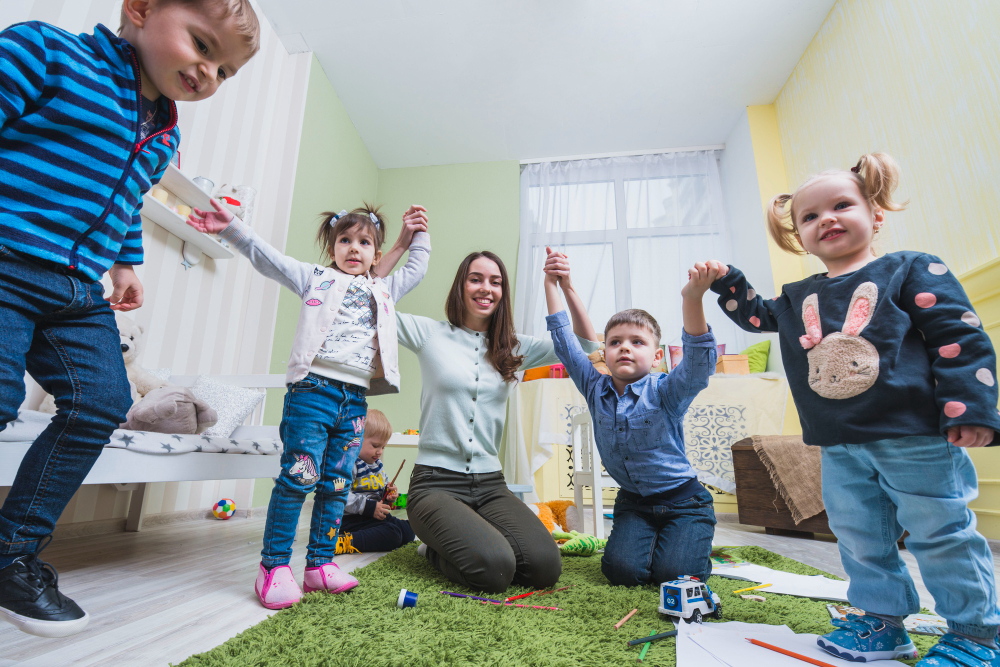
This is how natural adaptation to society occurs. Emotional intelligence develops through everyday situations : the child learns to recognize his own feelings, notice the emotions of others, and show empathy. And joint games and projects, interaction with peers, gradually form such an important skill as teamwork .
Daily routine, independence and discipline
A predictable routine helps your child understand what comes next: activities, walks, meals, rest, play. This creates a sense of stability and at the same time teaches them to follow rules.
In kindergarten, the child gradually does more independently: gets dressed, cleans up after play, keeps track of his belongings, and carries out simple tasks. It is important that this does not happen through strict control, but through regular practice and support from an adult.
School readiness and intellectual development
Good preparation for school is much more than just reading and math. A child will need concentration, developed speech, logic, memory, curiosity, the ability to listen to instructions, and the ability to work with others.
At m . Kids, the educational environment is built around comprehensive development: programs cover reading and writing, math and critical thinking, English, social skills, financial literacy, technology, creativity, and sports. Additional developmental clubs help the child discover his or her own interests and strengths.
Alternative to kindergarten: is it possible to raise a socialized child at home?
Yes, you can. If a child stays with mom, dad, grandma, or if the family has a nanny to help, this in itself does not mean that the child has a developmental problem. But adults will have to consciously create opportunities for the experiences that occur in kindergarten every day.
If we analyze the query child without kindergarten pros and cons , the advantages of the home format can be a familiar environment, flexible schedule and a lot of personal attention. Among the potential disadvantages are the lack of communication with peers and fewer situations in which you need to negotiate and act independently without the help of a close adult.
Another risk is overprotectiveness , where the child is constantly being made decisions for, helped before they ask, or tried to protect them from any discomfort. In this case, opportunities to practice independence become fewer.
So, is it possible not to take a child to kindergarten ? Yes, but then it is important to ensure regular contact with children, group classes, active walks, creativity and gradual expansion of independence. Alternatives to kindergarten may include early development groups, sports and creative sections, joint classes with other children and short-term educational programs.
Myths and fears of parents: why does resistance arise?
“He will cry,” “they will insult him there,” “he will start getting sick all the time” – such thoughts are often not due to a reluctance to send the child to kindergarten, but rather a natural desire to protect him.
The question of whether a child is often sick in kindergarten is especially worrying for parents in the first months. Meeting a large number of people really means more contact with seasonal infections, so health and immunity issues should be discussed with a pediatrician, taking into account the condition of a particular child.
Similarly, the stress of kindergarten should neither be exaggerated nor ignored. A new space, unfamiliar adults, a different regime is a serious change. Therefore, a gradual adaptation period is important . Tears in the morning at the start do not always mean that kindergarten is not suitable for the child: it is important to assess their condition during the day, contact with the teacher, and the general dynamics of getting used to it.
Competent adaptation to kindergarten is built on predictability, adult support, and trust between the family and teachers. In m . Kids materials , adaptation is viewed as a gentle, gradual process with the support of the child and parents.
Advantages of a private kindergarten: why choosing a kindergarten or group makes a difference
Today, parents evaluate not only the program, but also the number of children in the group, the qualifications of teachers, safety, psychological climate, and the opportunity to receive feedback. This is where the advantages of a private kindergarten often manifest themselves .
For Ukrainian families abroad, inquiries about private kindergarten in Poland and private kindergarten for Ukrainian children may also be related to language and cultural adaptation. In such a situation, it is especially important to assess how the bilingual environment is organized , in what language the child communicates with teachers and peers, and how delicately the institution supports adaptation.
m . Kids emphasizes conditions in which the child is seen as a person: small groups , an individual approach , qualified educators , psychological and speech therapy support, and a safe space . This format gives teachers the opportunity to better notice the child’s needs, pace, interests, and changes in emotional state.
How to know if your child is ready for kindergarten: a checklist for parents
The question of how to understand that a child is ready for kindergarten is better assessed not by one sign, but by a set of skills and reactions. The main signs of readiness for kindergarten can be checked using a simple checklist:
- the child can stay for a certain period of time without mom and dad with another familiar adult;
- is interested in other children and tries to interact with them;
- can communicate basic needs through words, gestures, or other understandable means;
- gradually mastering age-appropriate self-care skills;
- is able to follow a few simple rules and instructions;
- is interested in new games, activities, and spaces;
- can turn to an adult for help;
- gradually adopts a regime and a repetitive sequence of events.
You don’t have to wait until a confident “yes” appears next to each item. Kindergarten readiness is not an exam. Some skills are already formed during adaptation.
The most important thing is not just to decide whether a child needs kindergarten, but to find an environment in which they will feel safe, have the right to their own pace, and receive daily opportunities to develop. When the family and educators act as partners, kindergarten becomes not a forced necessity, but the next step in the child’s growth.